Shibusawa Ei'ichi Memoial Foundation/Resource Center for the History of Entrepreneurship

[help]

Shibusawa Eiichi Foundation outline Shibusawa Memorial Museum Resource Center for the History of Entrepreneurship Research Dept. Home Japanese
Establishment
Company History(Shashi) Project
Woodblock Print(Nishiki-e) Project
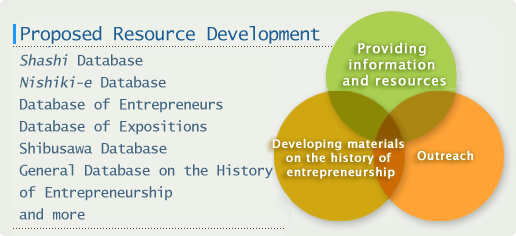
Projected databases:Company history database/Business history woodblock print database/Entrepreneur profile database/Exposition and trade fair database/Shibusawa-related information database/Comprehensive business history database*********Information Resources created/Collection scope expanded/Outreach*********

Utilizing the advanced information technology of today, the Shibusawa Memorial Museum realizes the idea of a museum of Japanese business history first proposed in 1937 by Shibusawa Keizo (1896-1963) in commemoration of the life and achievements of his grandfather, the industrialist and philanthropist Shibusawa Eiichi (1840-1931).

Background
Today, cultural institutions are shifting from their former role in the "enlightenment of the masses" to the encouragement of public access and engagement. Showing great foresight, Shibusawa Keizo led the compilation of a variety of indexes of documents, artifacts, and other materials and the invention of the pictorial index. This background makes the Shibusawa Memorial Museum an eminently suitable site for the establishment of the Resource Center for the History of Entrepreneurship, making the Museum an up-to-date cultural facility that serves as both an information-resource provider and an archive of historical documents and artifacts.

The museum of business history envisioned by Shibusawa Keizo was intended to exhibit the trajectory of the national economy at a time of momentous changes involving modernization, industrialization, and commercialization, and popular responses to them. His vision stressed the traditions of manufacturing and focused on the encounter with foreign cultures, acculturation, and the popular response from the nineteenth century onward. Special attention was to be paid to the activities of those who had lead the dramatic changes and helped pave the way for the new age.

Today, we take up this vision for a business history museum proposed more than sixty years ago because that history is as important to us now as it will be to future generations. We stand at a turning point; it is our urgent task, for the sake of the survival of human civilization, to move away from ceaseless expansion and growth as the organizing principles of economy and society and build stable, sustainable systems of production and commerce on a global scale. We believe that providing a wealth of resources for reevaluating economic development and manufacturing and for refocusing the study of entrepreneurship on people rather than organizations or the state can provide the keys to opening up the path to a better future.

Functions
First, the Center will develop and organize databases of the Shibusawa Museum's collection as well as documents and artifacts located elsewhere, maintaining a central information resource for research on the history of modern entrepreneurship in Japan. These databases will contain systematic information about historical documents and other materials, the location of such materials, and cumulative achievements of research. The databases will seek to contribute to research, teaching, and independent study on business history.

Second, the Center will improve and expand the Museum's collection of materials related to the transition from a premodern to a modern economy, the backdrop for the times in which Shibusawa Eiichi lived. New items collected will be in a variety of formats: written and printed documents, visual and audio records, film and video images, artifacts, and so on (including both originals and secondary sources).

This expanded and amplified collection will be made widely accessible through exhibitions both within the Shibusawa Museum and at other locations and databases and other resources will be made available on the Internet. In addition, the Center will actively support research, publishing, and the production of learning-promotion kits.

With the establishment of the Resource Center for the History of Entrepreneurship, the Shibusawa Memorial Museum will expand the scope of its collection and refurbish its exhibits and facilities, making it a model of a new cultural facility that integrates the functions of museum, archives, and library/information service.


Shibusawa Keizo's Vision for a Museum of Japanese Business History
In 1937, Shibusawa Keizo presented his original plan for a museum of Japanese business history to the Ryumonsha, a foundation established by Shibusawa Eiichi (also known as Seien) in 1924 and now known as the Shibusawa Ei'ichi Memorial Foundation. In defining its mission

the original plan stated:

. . . Whereas the advancement of the culture of a nation and its people may be measured in the quality of its museums. . . we hereby seek to construct a museum of the modern history of the economy here on the grounds of Aii-sonso [Aii-son villa]. . . .
Among such museums, as yet no plan can be found for a museum on the economy distinguished by its attention to materials relating in particular to the remarkable and epochal changes of our people in the period of transition from the end of the regime of the Tokugawa and the launching of the Meiji state in 1868. We would leave to other institutions the creation of exhibits on themes of economic history prior to modern times, which are often difficult to separate from other aspects of basic culture. Regarding the artifacts of modern industry resulting from the application of recent science and technology we leave these as well to a museum of industry to someday be built. Thus the historical museum of the modern economy we propose to construct would be concerned with the period beginning just before the birth of Shibusawa Eiichi [1840] and extending to the end of the Meiji era [1912], an epoque that coincides with a phase of dramatic economic development of the nation.

Regarding the envisioned museum size and content, early documents propose three main exhibition facilities, described as follows:

Seien Memorial Hall (333 square meters)

Through exhibits of treasured mementos, photographs, writings (including examples of handwriting and published works), architectural models, dioramas, and various charts and illustrative materials, a chronology of the Eiichi's life should be displayed. This should be done in order to vividly illustrate the many changes as well as the continuities that characterized his multifaceted career. This room should cover all aspects of his activities, not only as a businessman but also as a leader in education, international friendship, labor issues, and philanthropy.

Hall of Modern Economic History (1,485 square meters)

The following items are to be chosen and displayed for business education and social edification: basic sources showing the scale, degree, and direction of the changes and developments of Japanese economic history from the Bunka-Bunsei eras (1804-30) to the end of the Meiji era (1868-1912); sources related to the transformations and reaction as a result of the introduction of new cultures; artifacts important to the history of business; and articles to be displayed in an especially interesting manner. This being the case, the majority of matters relating to military affairs, diplomacy, politics, scholarship, the arts, religion, aristocratic culture, as well as popular culture need not, in principle, be considered for the collection, except when deemed necessary. Books and other documentary artifacts are to be entrusted to the Seien Bunko (Seien Library).

Portrait Gallery (165 square meters)

Portraits of all those persons, without distinction as to the scale of their achievements great or small and irrespective of rank and social status, who contributed to the culture of Japan's modern economy, including businessmen, entrepreneurs, industrialists, manufacturers, agriculturists, mine operators, fishery operators, scholars, critics, inventors, innovative farmers, and others should be collected and framed for display. These portraits, accompanied by full identifying and biographical information, should be put on display, classified by category, to encourage respect for and gratitude to our forebears. This room is to be a gallery of the famous useful in furthering the purposes of community and adult education.

museum rendering
The museum, an original rendering...

Chronology of the vision

1937 Idea for museum proposed by Shibusawa Keizo
Ryumonsha approves plan for Museum of Japanese Business History (MJBH) in commemoration of Shibusawa Seien (Eiichi)
Acquisitions for museum collection begin.
1939
May 13.Site-purification ceremony held at Aiison-so, Shibusawa family estate (Nishigahara, Tokyo)
1941 Postponement of construction due to outbreak of Pacific War
1943 Preparations office and collection moved to Sakatani residence in Koishikawa, Tokyo
1945 Sakatani residence requisitioned by Allied Occupation
1962 Collection entrusted and later donated to what is now the Department of Historical Documents, National Institute of Japanese Literature (formerly Ministry of Education Historical Archives)
1982 Shibusawa Memorial Museum founded
2002 Digitization of collection of former Museum of Japanese Business History Preparations Office
back to top
About This Site Sitemap Links Contact and Access
Copyright Reserved by shibusawa Ei'ichi Memorial Foundation 2002-2006